ISO-5 Optical Cleanroom
A cleanroom lab built to turn phone cameras into spectral instruments.
 Eddie OffermannFounder and CTO
- Role
- Founder and CTO
- Areas
- Optics, Hardware, Research, Computer Vision
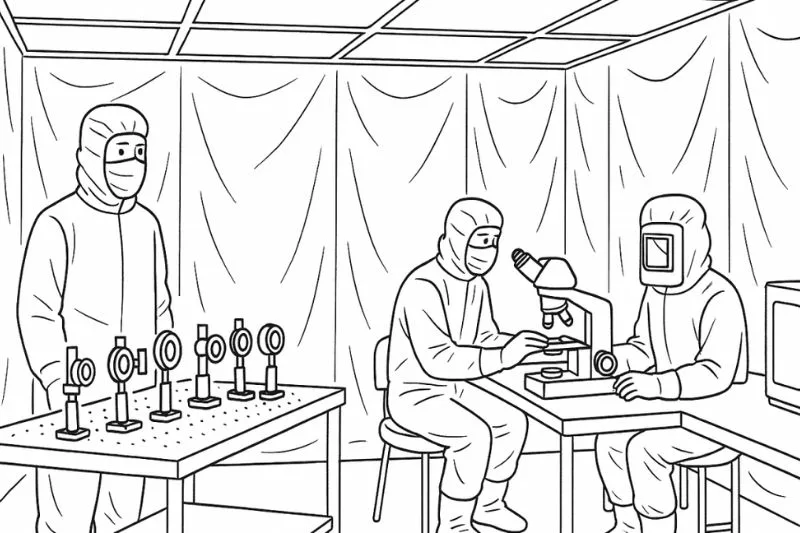
Our work increasingly depends on generating controlled, measurement-grade data.
We built this cleanroom for one question: how much spectral information is hiding in the ordinary camera of a phone?
A phone's image sensor sits behind a mosaic of red, green and blue filters designed to make pictures that look right to people. The silicon and its filters actually respond to light more broadly and more messily than those three channels suggest, and the overlap and the leakage carry information that normally gets thrown away. Our hyperspectral imaging research, now the subject of a filed provisional patent application, recovers that information: given a careful characterization of a sensor and a learned mapping from its RAW pixels to spectra, an unmodified phone can estimate a spectrum for every pixel instead of three numbers. Hyperspectral cameras that measure this directly are expensive, bulky and slow. Phone cameras number in the billions.
The whole method rests on measurements, and that's what the room is for.
What the research asks of the room
Characterizing a sensor. We light a calibrated white reflectance target with one narrow band of wavelengths at a time and record how each color channel of the camera responds, in RAW, across many wavelengths, exposure times and gain settings. The result is the sensor's spectral sensitivity, including its leakage outside the bands each channel nominally covers. We repeat it across several units of the same phone model, to separate the model's typical response from each unit's own deviations.
Paired capture. To learn the mapping from sensor values to spectra, the phone and a reference spectral camera photograph the same scene at the same moment, registered to each other with checkerboards and fixtures, so every phone pixel can be paired with a measured spectrum.
Both only work if a measurement taken today matches one taken next week. A speck of dust on a filter, a lens or a reflectance standard changes the numbers, and it can do so halfway through a data-collection run without anyone noticing. Assembling an optical fixture and finding dust sealed inside it later is worse. The cleanroom exists so that neither happens.
The room
We built it ourselves, inside an existing room, rather than buying a prefabricated softwall unit, so we could use the space we wanted at the size we wanted.
- Sealed. Walls, floor and ceiling are sealed in heavy plastic sheeting, with magnetic zippered entries and an emergency zippered exit straight outside.
- Positive pressure. A three-stage HEPA air scrubber blows filtered air into the room, so whenever a flap opens, and around any imperfection in the seal, air flows out rather than in. It's the opposite of a containment room, which runs under slight vacuum to keep things in.
- An airlock. A curtained anteroom with steel shelving holds the protective gear: coveralls, shoe covers, masks and 10 mil nitrile gloves. Nobody enters the bench area without it.
- Nothing dusty comes in. Stainless steel tables and new shelving, which are easy to wipe down, instead of furniture that had been sitting in the building gathering dust. Floor tiles over the sealed floor protect the plastic underfoot.
- Its own light. The building's lighting is sealed behind the plastic, so the room has its own daylight-balanced LED fixtures and clamp lamps. Blackout cloth around the bench kills stray light during measurements.
- Watched. A handheld sub-micron particle counter tells us when conditions drift far enough that the lenses should go away.

Because the light sources reach into the ultraviolet and the infrared, the lab keeps UV-rated and IR-rated safety glasses alongside the rest of the gear.
The bench
The bench is modular, so test assemblies, imaging rigs and sensor fixtures swap without rebuilding the setup.
- Light. A tungsten-halogen spectroscopy illuminator, a stable source with a smooth, continuous spectrum from the near ultraviolet into the shortwave infrared.
- Wavelength selection. Two manual monochromators, 300 to 800 nm and 500 to 1200 nm, which disperse the broadband light and pass a narrow band of it. Interchangeable 100-micron slit sets set how narrow.
- Filtering. Long-pass filters at 400, 500, 750 and 850 nm, used to make sure no stray shorter-wavelength light leaks into a measurement.
- Delivery. Fiber-optic patch cords in UV/visible and visible/near-infrared versions, since a fiber made for one end of the spectrum performs poorly at the other.
- References. A Spectralon white reflectance standard, nearly perfectly diffuse with stable, known reflectance, plus color charts with published reflectance values and checkerboard targets for geometry.
- Cameras. Phones under test, with every automatic feature locked, alongside lab machine-vision cameras chosen for their wide spectral response, including a near-infrared-enhanced monochrome camera.
- Motion. A robot arm running our own control software, for positioning cameras repeatably.

An early finding
Before the first sweep, we wrote the software to pull RAW, sensor-native data off phones, and the phones had opinions. Getting RAW images from the rear cameras is fairly standard on both iOS and Android, with quality that varies but is usually good. Front cameras are a different story: many devices simply won't deliver RAW from them, through restrictions that appear to be baked into the hardware. That changes which data is available from which camera, so we characterize both the front and rear cameras of every device.
What the data is for
Spectral data tells materials apart that look identical to the eye. The applications the research targets include plant health and stress in agriculture, tissue and wound imaging in medicine, pigment identification in art and cultural heritage, material sorting and quality control in industry, water and pollution monitoring, and color-accurate, material-aware rendering in augmented reality.
Beyond one project
The cleanroom also ties our GPU-accelerated AI, XR prototyping and spatial computing work to physical measurement and calibration, so the data our models learn from is data we can trust. It's one of several specialized spaces we work across, alongside an XR lab, a GPU compute bench and a fabrication workshop. Next for the lab: more monochromator capacity, automated optical-path alignment, better spectral reference standards and end-to-end sensor-testing workflows. We're open to a limited number of collaborations with partners in precision imaging and measurement.
Sources
Related work
-

Computational Optics
Hyperspectral images from the ordinary camera in a phone.
-
CameraSmartPlate
A camera plate that knows where it is, for tracking, virtual production and NeRF capture.
-

HoloFlect
A modular, upgradeable AR headset platform built for enterprise.
-

Mixed-FOV Depth Sensing
Pairing an ultrawide depth sensor with a narrow one for detail where it matters.