Aesopic
AI-assisted long-form fiction, structured from series concept down to the page.
 Eddie OffermannCreator
- Role
- Creator
- Areas
- AI, Tools

Most AI writing tools are word processors with AI bolted on, or chat systems tuned for roleplay and short pieces. Aesopic is built for the opposite end: very long, structured fiction, up to a series of novels or multiple seasons of a show, where the hard problem is keeping the arcs coherent across hundreds of pages.
It isn't meant to replace the author. The author arrives with an idea, a sense of who the hero is and a rough shape of the arc, and Aesopic does the scaffolding: worldbuilding, character backstories, the connective tissue between scenes and first-draft prose the author then rewrites and makes their own.
A pipeline that mirrors how authors plan
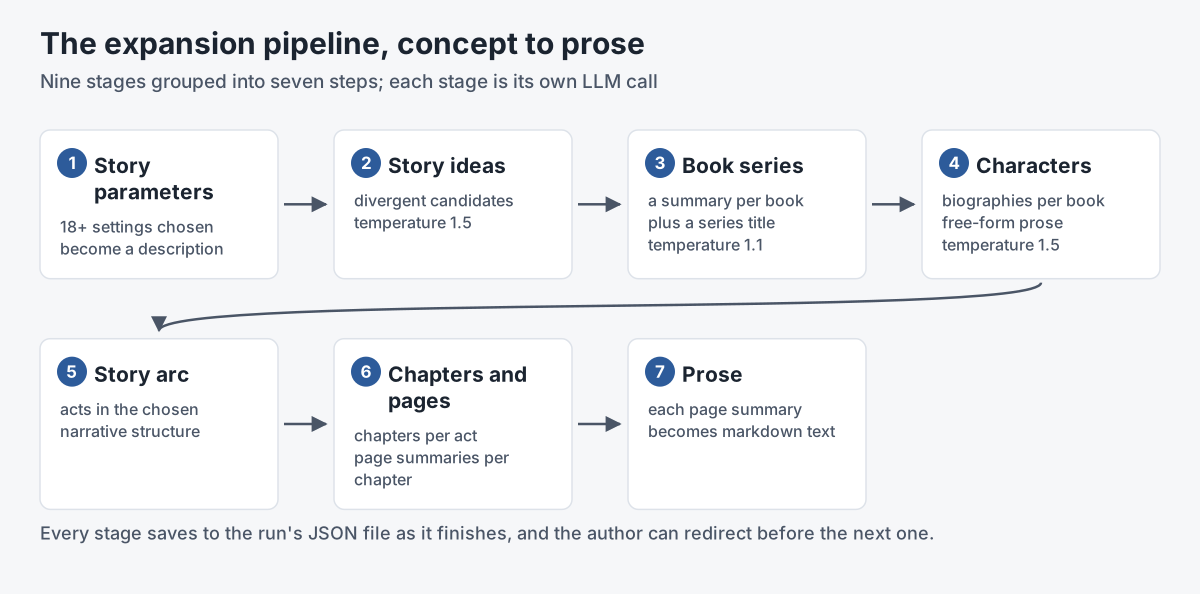
Our thesis is that long-form fiction needs hierarchical structure, so the system expands a story the way an author plans a series, refining at each level:
- Story parameters become a description, and the model proposes divergent story ideas.
- One idea becomes a book series with a summary for each book, plus a series title.
- Each book gets character biographies and a story arc in the narrative structure the author chose, from the standard arc and the Hero's Journey to Kishōtenketsu, Rashomon and a fractured timeline.
- Each act becomes chapters, each chapter becomes page summaries, and each page summary becomes prose.
Every level runs in its own named conversation thread, which can be forked, so a chapter in Act 1 of Book 1 keeps its own context without polluting the others. Each stage is saved as it finishes, so a partial run is never lost, and the author can review and redirect at every level before expanding further.

Notable choices
- Local first. Quantized open models run on the author's own GPU through llama.cpp, with a registry of model profiles from 8B to 72B parameters, including creative-writing fine-tunes.
- Synthetic authors. Instead of prompting with real writers' names, we generated 120 invented author personas across 12 genres, each with a detailed style description, using grammar-constrained generation. That gives a consistent voice without copying anyone.
- A deep parameter set. Genre, trope, period, setting, society, tone, themes, point of view, pacing, humor, twists and morality are all selectable, and they randomize on load to make exploring easy.

"The Weaver and the Loom", a short fable about human craft and a mechanical loom, was written by one of Aesopic's modules: the theme was ours, and the characters, setting and story were the model's. Aesopic grew out of the same research into LLM-assisted long-form content as AuRA.
Sources
Related work
-

AuRA Avatar Generator
Customizable, photorealistic presenters for AI-generated video briefings.
-

b2c3d
Traditional 3D content creation, rebuilt with AI inside the tools.
-
B2CQuantizer
Batch quantization of Mistral models from a browser, on a rented GPU.
-
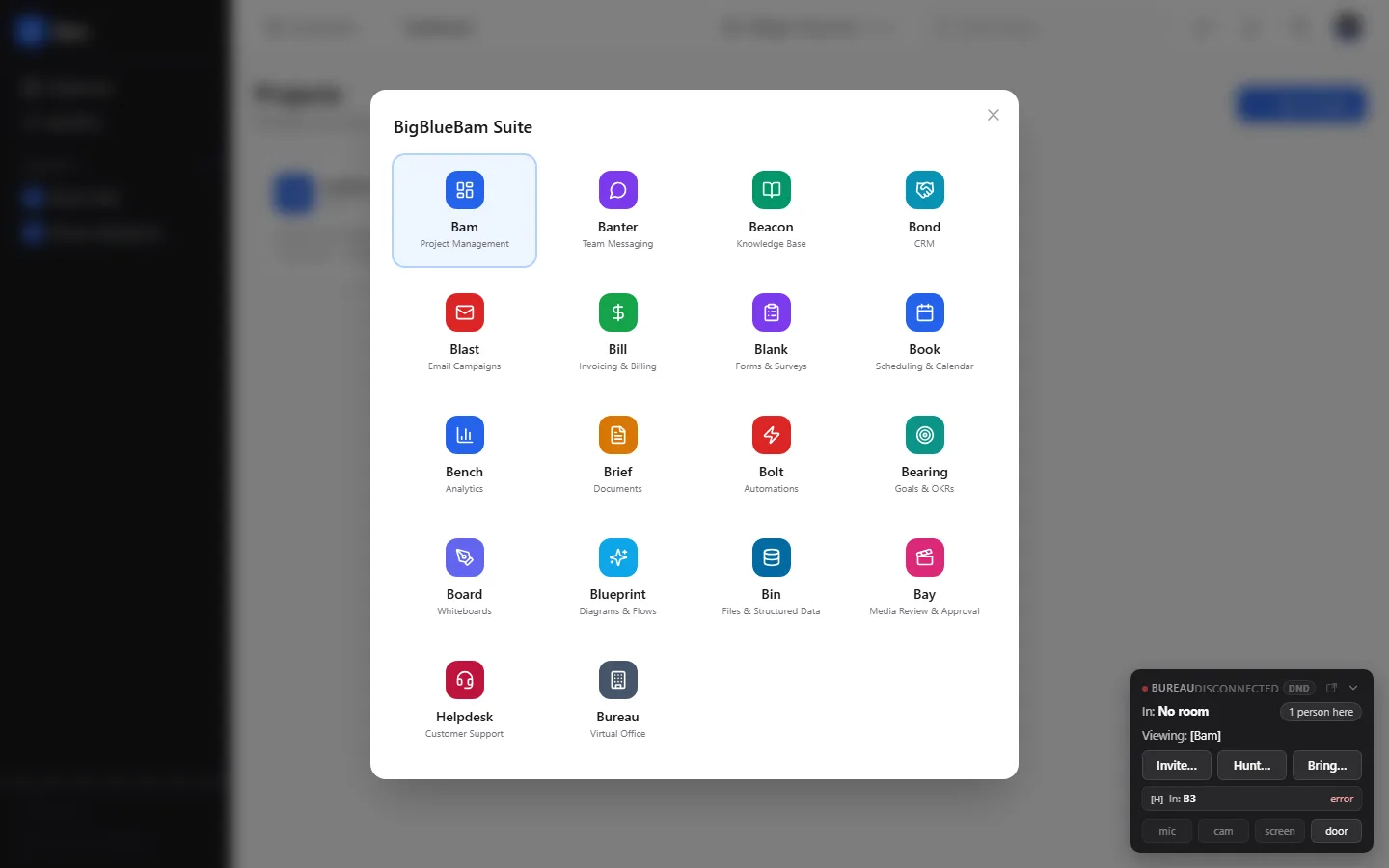
BigBlueBam and the B-Suite
A work suite where AI agents work alongside people, with the same permissions.